

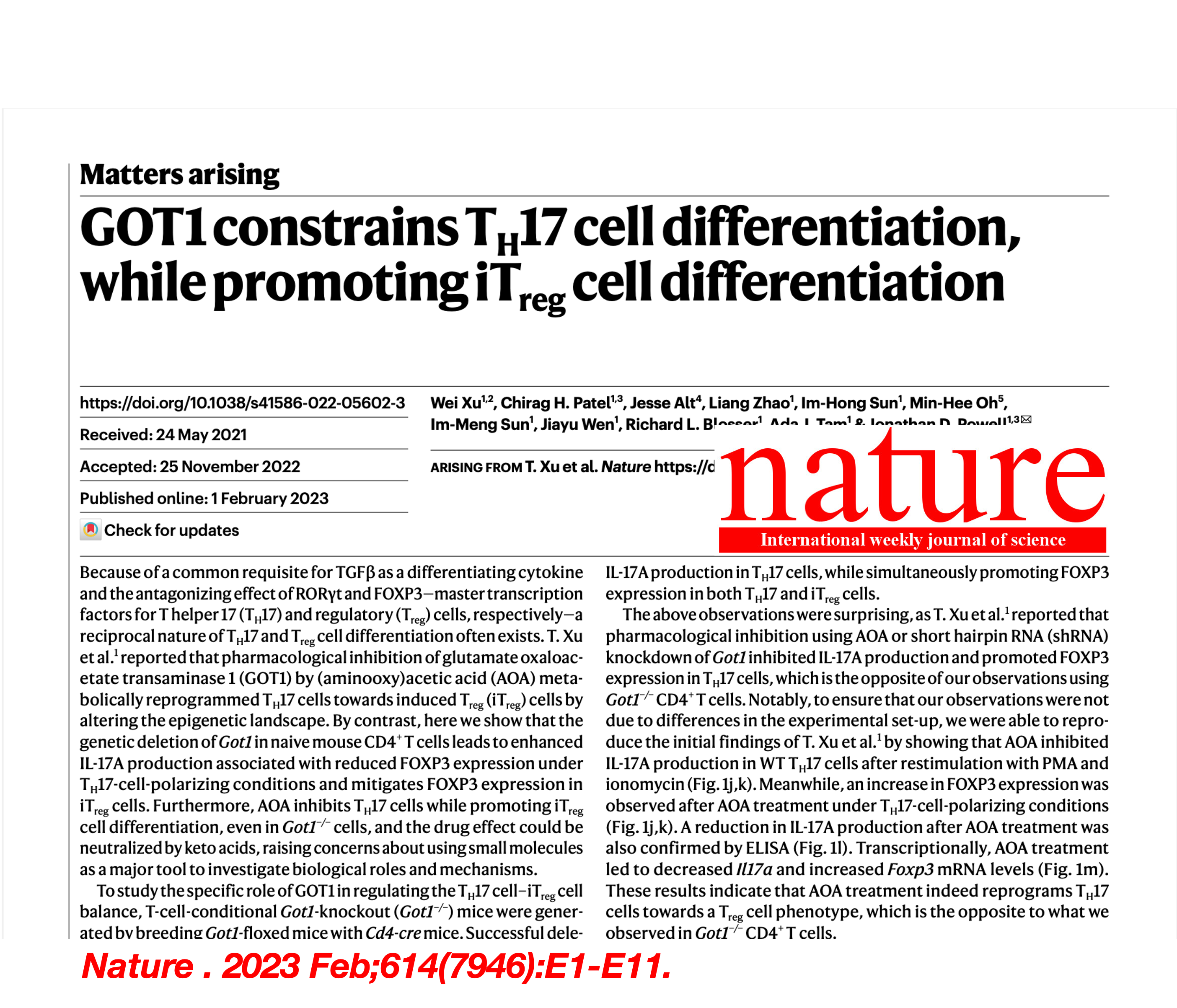
Because of a common requisite for TGFβ as a differentiating cytokine and the antagonizing effect of RORγt and FOXP3—master transcription factors for TH 17 and Treg cells, respectively—a reciprocal nature of TH 17 and Treg cell differentiation often exists. A pan-transaminase inhibitor, AOA, was used widely in research to study the functions of glutamate oxaloacetate transaminase 1 (GOT1) in regulating the TH17 cell–iTreg cell balance. In contrast to a previous study, our study here shows that the genetic deletion of Got1 in naive mouse CD4+ T cells leads to enhanced IL-17A production associated with reduced FOXP3 expression under TH 17-cell-polarizing conditions and mitigates FOXP3 expression in iTreg cells. Furthermore, our findings in this study also raise concerns about using small molecules as a major tool to investigate biological roles and mechanisms.
We hypothesized that AOA, when using as a pharmacological inhibitor of GOT1, its role might be neutralized by the keto acids present in the organism. Therefore, instead of using small molecule inhibitor as a tool for studying GOT1, we tried with the genetic deletion approach and generated a T-cell-conditional Got1-knockout mice model for this study.
This is a good example of the application of metabolomics in identifying off-target effects of small molecule drugs. In combination of metabolomics analysis and traditional metabolite profiling approach, we not only identified distinct metabolic profiles for Got1−/− and AOA-treated WT TH 17 cells, but also confirmed that AOA can chemically reacted with the intracellular keto acids.
Our Approach
To study the specific role of GOT1 in regulating the TH 17 cell–iTreg cell balance, we used different technologies to characterize the difference between Got1−/− and AOA treatment. Flow cytometry and ELISA analyses indicate that GOT1 inhibits IL-17A production in TH 17 cells, while simultaneously promoting FOXP3 expression in both TH 17 and iTreg cells. Furthermore, we performed metabolomics analysis, our results indicate that the effect of AOA in modulating TH 17 and iTreg cell differentiation is not due its metabolic inhibition of GOT1, but is because of the modulation of other targets. While RNA-seq analysis revealed increased glycolysis, OXPHOS and fatty-acid metabolism in Got1−/− TH 17 cells. These observations were consistent with previous studies showing that these metabolic activities promote the generation of TH 17 cells over iTreg cells.
Our Conclusion
In summary, we have shown that GOT1 has a negative role in TH 17 cell differentiation but simultaneously promotes FOXP3 expression using genetic knockout models. GOT1 deficiency leads to an increase in IL-17A production and a reduction in FOXP3 expression, in contrast to the previously report using AOA. Given the fact that AOA can inhibit IL-17A production and promote FOXP3 expression, our study raises caution about the suggested metabolic–epigenetic mechanism mediated by αKG and 2-HG, by showing that AOA chemically reacts with keto acids. Rather, GOT1 deficiency leads to increased glycolysis, OXPHOS activity and fatty-acid synthesis, which are all important metabolic programs associated with TH 17 cell differentiation. Our research shows that targeting GOT1 is not an ideal therapeutic strategy for TH 17-cell-mediated autoimmune diseases, because Got1−/−CD4+ T cells produce more IL-17A under both in vitro and in vivo TH 17 cell conditions.