

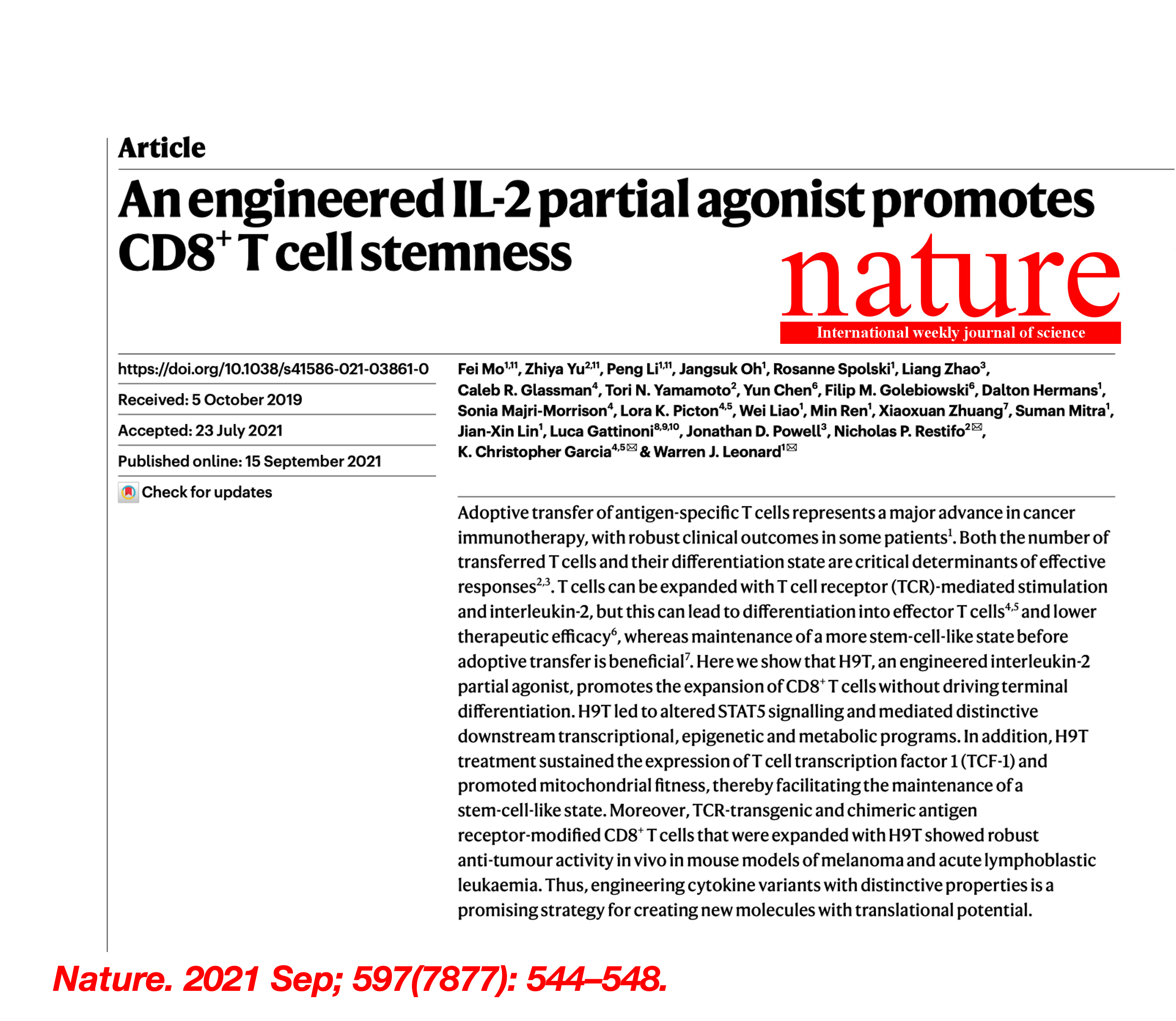
Interleukin-2 (IL-2), which was originally discovered as T cell growth fac tor, is experiencing a resurgence of interest in cancer immunotherapy. In clinical, adoptive transfer of antigen-specific T cells represents a major advance in cancer immunotherapy, with robust clinical outcomes in some patients. T cells can be expanded with TCR-mediated stimulation and interleukin-2, but this can lead to differentiation into effector T cells and lower therapeutic efficacy.
We hypothesized that harnessing the desirable properties of IL-2 while minimizing detrimental ones so that to maintain the T cells with a more stem-cell-like state before adoptive transfer, which will be beneficial for the immunotherapy.
This paper demonstrates how to utilize multi-omics technologies (including transcriptomics, epigenomics and metabolomics) for characterization of this innovative partial agonist of IL-2, H9T, and its working mechanism of helping to maintain T cells in a stem-cell-like state. More importantly, our metabolomics analysis successfully provided strong evidence of the distinctive properties of H9T as an engineered cytokine that could support T cell proliferation while limiting glycolysis and exhaustion.
Our Approach
After generating the H9T by introducing a single mutation in H9 at the H9-IL-2Rg interface, we firstly performed RNA-seq analysis, which revealed that H9T-cultured cells had higher expression of stem-cell-like related genes. To better understand the transcriptomic differences, we next per formed assay for ATAC-seq, our data from H9T-expanded cells more closely resembled the patterns seen in in-vivo-generated populations of memory cells at the Havcr2 gene and at the Il10 locus, which are consistent with RNA-seq data. We also performed ChIP-seq analysis to further investigate the important role of STAT5 in CD8+ T cell exhaustion. Besides distinctive transcriptional and epigenetic profiles, our metabolomics data revealed that reduced levels of glycolysis contributed to the stemness phenotype induced by H9T.
Our Conclusion
In summary, we have characterized H9T, an IL-2 partial agonist that helps to maintain activated CD8+ T cells in a stem-cell-like state, with greater anti-tumour activity. By modulating the signals induced by IL-2, we provide evidence of the distinctive properties of H9T as an engineered cytokine that could support T cell proliferation while limiting glycolysis and exhaustion. More broadly, these findings indicate that new cytokine variants can be engineered with distinctive properties and translational potential.