

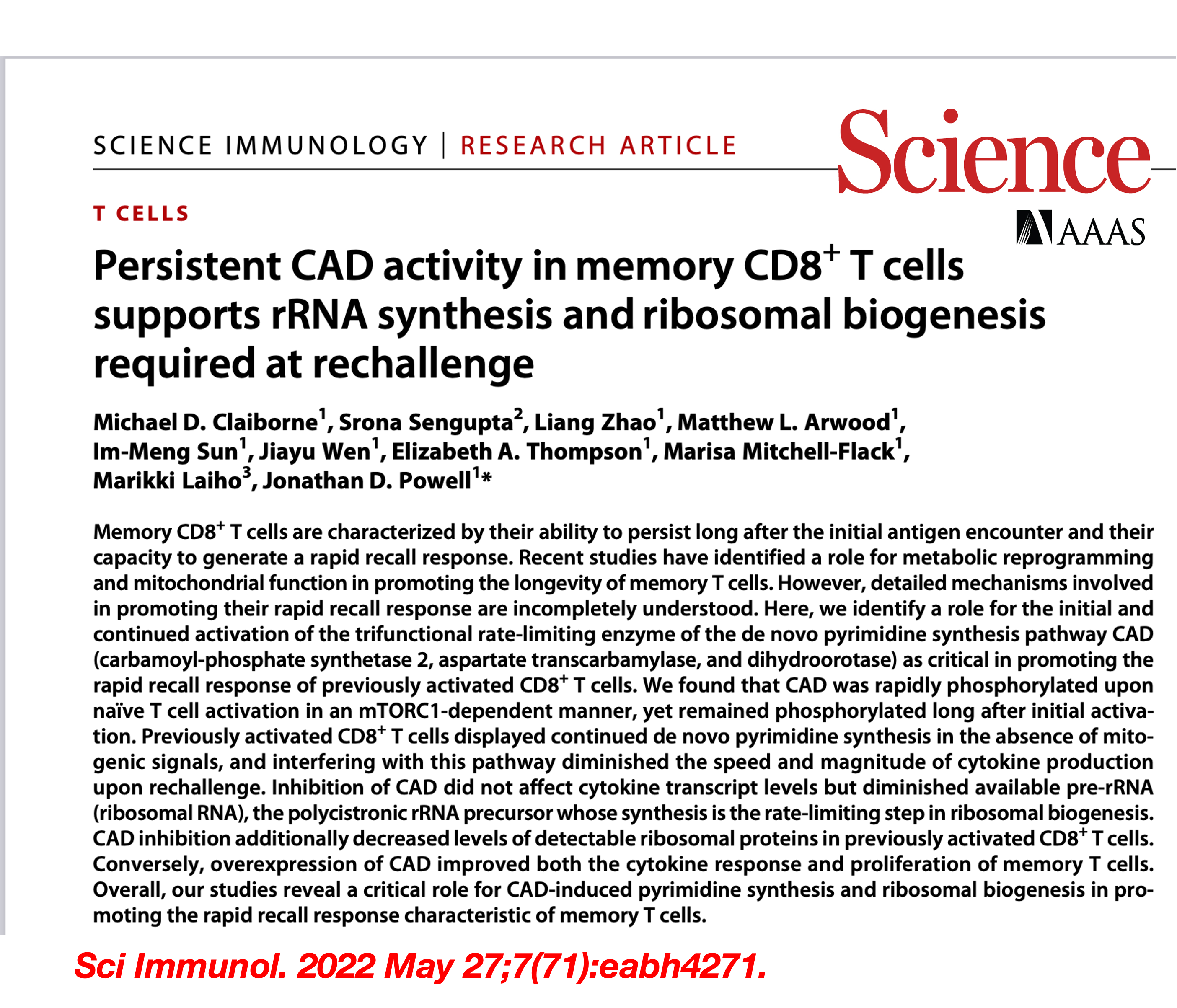
Memory CD8+ T cells are characterized by their ability to persist long after the initial antigen encounter and their capacity to generate a rapid recall response. Recent studies have identified a role for metabolic reprogramming and mitochondrial function in promoting the longevity of memory T cells. However, detailed mechanisms involved in promoting their rapid recall response are incompletely understood.
Given that full T cell activation leading to effector cell generation results in mTORC1 activation and CADinduced pyrimidine syn thesis is mTORC1 dependent, we hypothesized that the ability of mTORC1 to promote effector cell generation was due in part to the acute activation of CAD. Unexpectedly, although we did find that TCR engagement leads to CAD phosphorylation, we also observed that phosphorylated CAD (pCAD) remains detectable in resting cells long after T cell activation at a time when mTOR activity had returned to baseline. This prompted us to explore the role of persistent CAD activation in previously activated/memory T cells.
This study demonstrates using metabolomics and amide-labeled 15N-glutamine stable isotope tracing as powerful tools for exploring the activities of de novo pyrimidine synthesis pathway in previously activated/memory T cells.
Our Approach
To investigate the role of persistent CAD activation in previously activated/memory T cells, we firstly confirmed mTORC1dependent phosphorylation of CAD upon CD8+ T cell activation using flow cytometry. Next, we performed metabolomics and stable isotope tracing studies to demonstrate that the increased pCAD seen in previously activated CD8+ T cells in vitro correlates with an increase in both detectable metabolites in the de novo pyrimidine synthesis pathway and flux into this pathway via amide labeled nitrogen tracing. Furthermore, we performed qPCR and PrimeFlow RNA assay for the assessment of mRNA and pre-rRNA, our findings suggest a requirement in human CD8+ T cells for active CAD and that modulation of nucleotide availability or direct RNA pol I inhibition in previously activated cells before rechallenge can modulate the recall response.
Our Conclusion
Our studies indicate that the rapid and robust response of memory T cells is facilitated in part by the continuous generation of ribosomes such that, upon rechallenge, these cells are poised to rapidly respond. While overexpression of CAD and increased flux into de novo pyrimidine synthesis facilitated expansion of previously activated antigen specific CD8+ T cells. Therefore, increasing CAD activity could have implications in adoptive cell therapy or CAR T cell therapy in clinical settings for the treatment of malignancy. Alternatively, inhibition of ribosomal biogenesis could be used in the treatment of autoimmune conditions, in which the response of memory T cells is known to contribute heavily to pathology, such as multiple sclerosis.